How to Buy Your First Ghanaian Stock, Step by Step
A ten-step walkthrough for buying a first share on the Ghana Stock Exchange, including identification, costs, contract notes and a section for readers abroad. Buying a first share is mostly a matter of order. Do the thinking steps (1, 2 and 6) before you send any money. Opening an account does not oblige you to buy anything.
By Luther King · 17 October 2026
The ten steps
Decide how much you can invest. Use money you can leave invested for years, keep an emergency reserve separate, and decide what loss you could absorb. Minimum amounts vary by broker.
Understand your goal and time horizon. Retirement decades away is a different goal from school fees in ten years.
Choose a properly licensed intermediary. You go through a brokerage licensed by the SEC and admitted as a GSE Licensed Dealing Member (LDM). The GSE and SEC publish current lists. Confirm the firm's licence with the SEC rather than relying on advertising.
Open the securities and depository account. The Ghana Card is the general identification requirement. Under the SEC's 22 March 2024 directive, non-resident Ghanaians who cannot obtain it where they live may use a passport until they acquire it, non-resident foreign nationals may use a foreign passport or identity document, and diplomatic exceptions apply. Confirm your category and the full KYC requirements with your broker. Your broker also applies for a CSD account.
Fund the account, once steps 1, 2 and 6 are done. Use the firm's verified funding instructions and confirm the beneficiary account independently through official contacts. Keep your receipt. Never send money to an employee's personal account, and never share a password or one-time code.
Research the company. Parts 6 and 7 of this series show how.
Decide the price and quantity. Specify the ticker, share class, buy or sell, quantity, any limit price, and how long the order lasts. A limit price sets the worst price you will accept, but it does not guarantee the order is filled. Ask how partial fills, cancellations and amendments work.
Place the order by phone, in person or through the broker's app, whichever the firm offers. It goes to the GSE's trading system and is matched during trading hours.
Check the contract note and the costs. The GSE states a contract note must be issued within two business days after execution. Check the security, quantity, price, fees and total against your instruction.
Track the investment. Record the price, date, costs and your reasons, then review periodically.
What it costs
The SEC's 2026 guidelines set an equity transaction levy of 0.70%. The GSE's currently linked Trading Rules set an LDM commission of 0.10% to 1.80%. Together, that is combined commission and levies of 0.80% to 2.50% per transaction under the ordinary schedule. Both buyer and seller pay. Ask your broker for a written, all-in quote and for any additional charges before you order.
A worked budget (hypothetical)
With a GHS 1,000 budget, a GHS 10 share and an assumed 2.5% purchase cost, you can afford 97 whole shares: 97 × GHS 10 × 1.025 = GHS 994.25, leaving GHS 5.75. Buying 100 would need GHS 1,025. Orders can fill partly or at another permitted price, and 2.5% is the top of the published range, not a typical broker's charge.
Execution is not settlement
The CSD currently publishes standard equity settlement as T+3, meaning three business days after the trade date. Trading and settling are separate stages, so check for updated notices and verify your holdings in the depository record once the trade settles.
For readers abroad
Residence and citizenship are different questions. Ask your broker about remote onboarding, document certification, tax residence, account structure, funding currency, conversion costs, dividend payments and moving proceeds abroad. Keep transfer records.
A gain in cedis can shrink or turn into a loss in your home currency. With invented rates: USD 1,000 at GHS 10 per USD is GHS 10,000. After a 20% cedi gain it is GHS 12,000. At GHS 12 per USD that converts back to USD 1,000, a 0% return. At GHS 13 per USD it is USD 923.08, about minus 7.69%. A positive local return does not guarantee a positive home-currency return.
The short version: think first, verify your broker, get an all-in cost quote, and confirm the contract note and settled holdings.
Next in the series: Part 6, How to Understand a Company.
This article is for education only. It is not personalised investment advice, and it is not financial, tax or legal advice. Investing involves risk, including the possible loss of money, and past performance does not guarantee future results. Rules, charges and data change, so confirm current details with the Ghana Stock Exchange, the Securities and Exchange Commission (Ghana), the Central Securities Depository (Ghana) and your own licensed broker before acting. GSE Monitor is a market-information and portfolio-tracking product, and buying or selling shares still requires an account with a licensed broker.
Keep learning
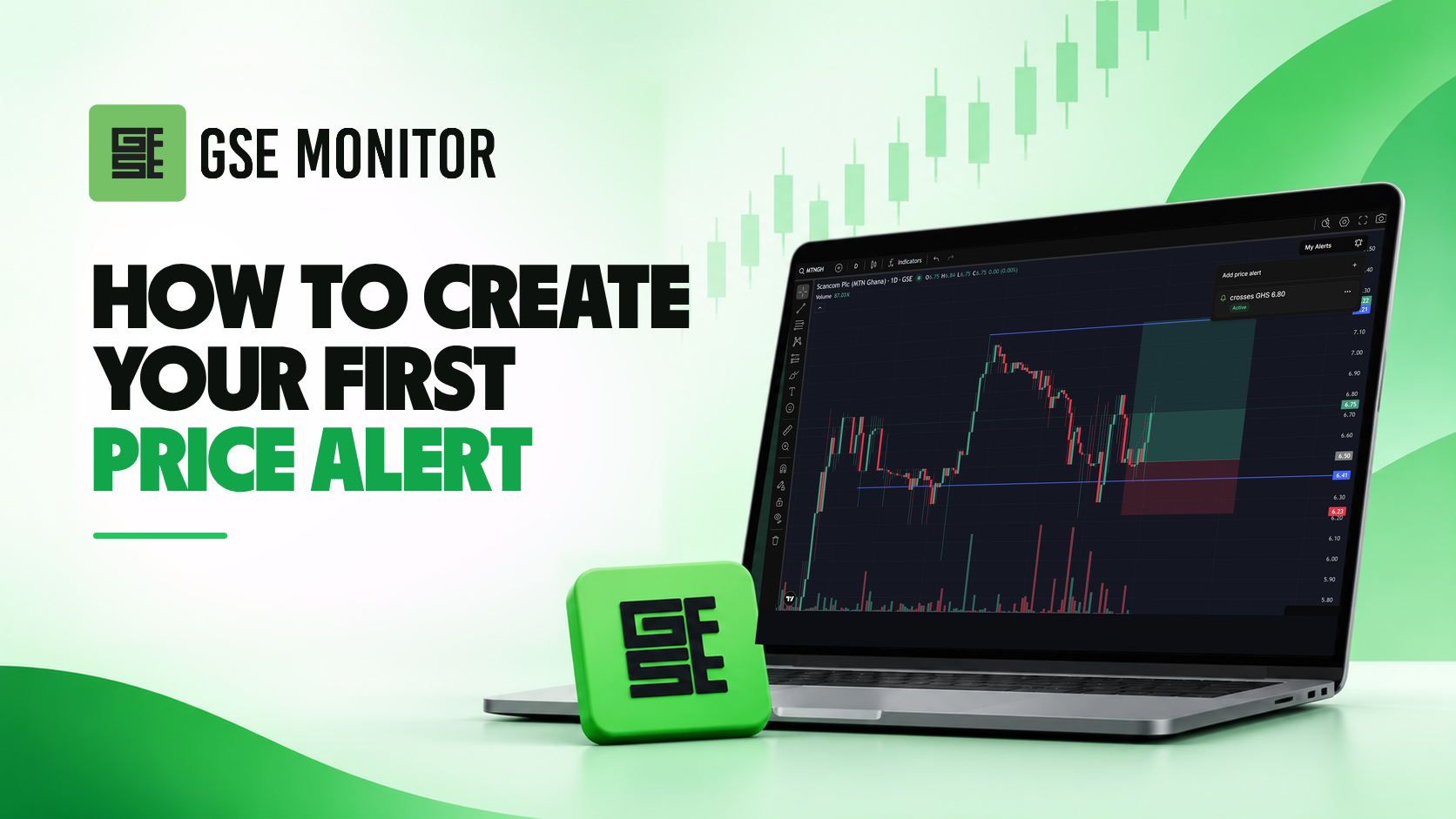
How to Create Your First Price Alert on GSE Monitor
A price alert emails you when a stock reaches the price you care about, so you do not have to keep checking the chart. You set it up in under a minute from the Charts page on GSE Monitor. This guide uses MTNGH as the example. The same steps work for any stock on the Ghana Stock Exchange.
Mistakes beginners make in the Ghana stock market
Mistakes beginners make in the Ghana stock market

Building your first portfolio and managing risk
Building your first portfolio and managing risk