Building Your First Portfolio and Managing Risk
Diversification, concentration, liquidity, and risk capacity explained for beginners, with three hypothetical investors. A portfolio is more than a pile of shares you like. It is a set of holdings shaped by your goals, your time horizon, and, just as important, how much loss you can actually absorb. This article gives you the ideas to think with. It does not tell you what mix to hold.
By Luther King · 17 October 2026

Diversification and its limits
Diversification reduces your dependence on one company or sector. Owning five unrelated companies is generally less risky than putting the same money into one, even if one of the five might have done better alone.
But five Ghanaian shares can still share the same currency, policy, interest-rate, and economic risks. The number of holdings is not enough: look at how much each one weighs, what each is exposed to, and whether they overlap. Diversification cannot remove market-wide losses.
Six things to think about
Concentration: how much of your portfolio sits in a single stock or sector.
Sector exposure: whether you are spread across banking, telecoms, consumer goods and so on, or clustered in one industry.
Company-specific risk: problems unique to one business, such as a lawsuit, a leadership change, or a lost contract.
Liquidity: how easily you could sell if you had to. This varies a lot between GSE-listed shares.
Time horizon: how long you can leave the money invested before you might need it.
Risk tolerance and risk capacity: tolerance is how comfortable you feel watching values move. Capacity is how much loss your income, reserves and obligations can really absorb. They are not the same thing.
Three hypothetical investors
Investor A has a long time horizon. The money may not be needed for decades. A long horizon may allow Investor A to consider more equity risk, provided income stability, an emergency reserve, debts, and obligations support it. Age and time horizon alone do not decide the right mix.
Investor B is saving for a goal in about three to five years. With a firmer deadline, Investor B may weigh deposits, T-bills, bonds or a fund whose mandate fits the date more heavily, and use equities more cautiously, since a shorter runway leaves less time to recover from a fall. Investor B's reserves and obligations matter as much as the deadline.
Investor C wants income. Investor C might lean towards dividend-paying shares and coupon bonds. Dividends and coupons are uncertain, so the capacity to absorb a cut matters.
These illustrate how considerations differ. They are not recommendations for what you should hold, which depends on your whole financial picture, ideally discussed with a licensed adviser.
Starting small is fine, with care
You can start small, but one holding is still a concentrated position. Keep its size within the loss you can absorb, consider an appropriately diversified fund where suitable, and review weights as contributions and prices change. Trading costs matter more when positions are small.
The short version: spread risk thoughtfully, check what your holdings have in common, and size positions by what you can afford to lose.
Next in the series: Part 10, Mistakes, Scams and Your Checklist.
This article is for education only. It is not personalised investment advice, and it is not financial, tax or legal advice. Investing involves risk, including the possible loss of money, and past performance does not guarantee future results. Rules, charges and data change, so confirm current details with the Ghana Stock Exchange, the Securities and Exchange Commission (Ghana), the Central Securities Depository (Ghana) and your own licensed broker before acting. GSE Monitor is a market-information and portfolio-tracking product, and buying or selling shares still requires an account with a licensed broker.
Keep learning
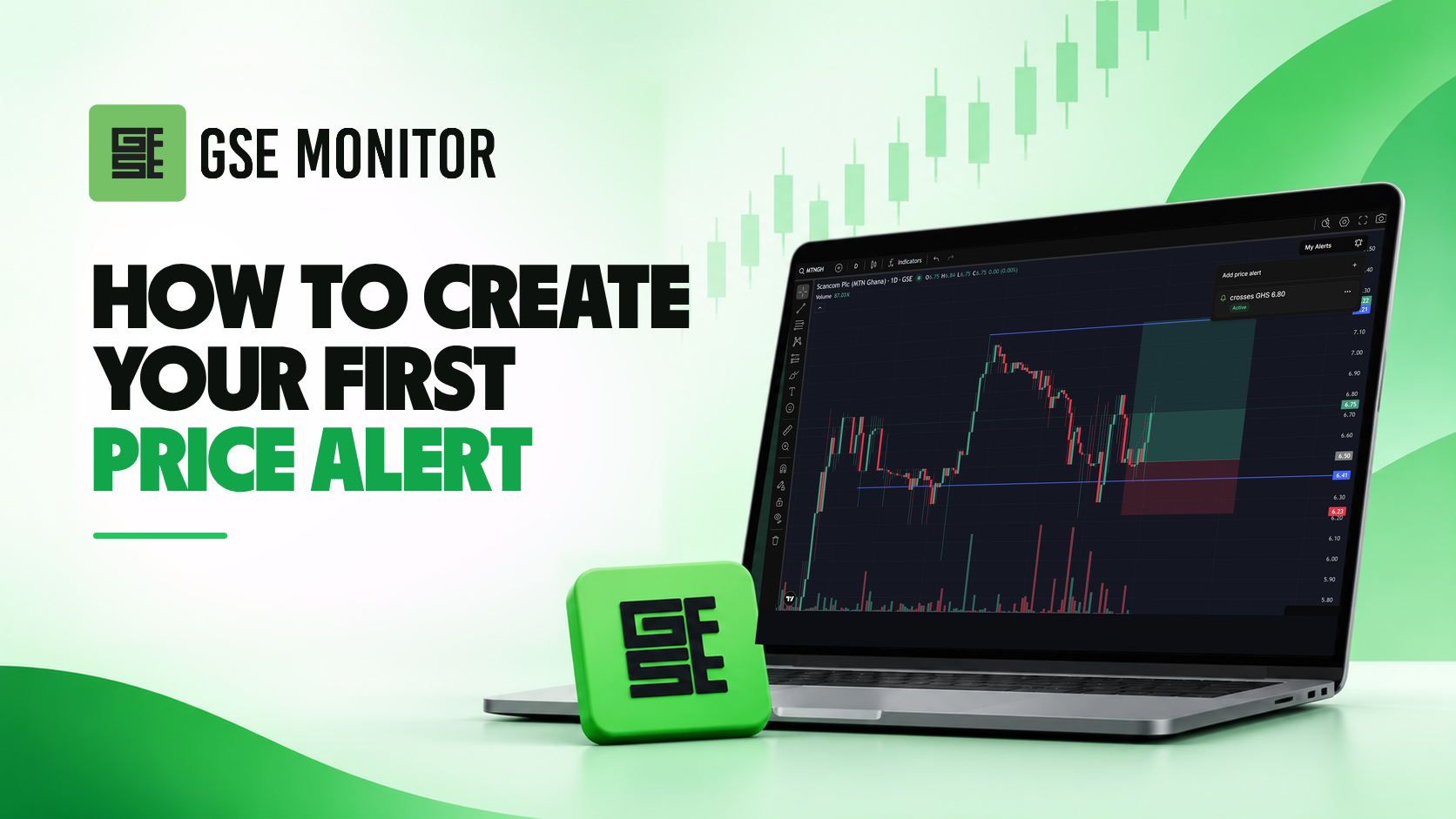
How to Create Your First Price Alert on GSE Monitor
A price alert emails you when a stock reaches the price you care about, so you do not have to keep checking the chart. You set it up in under a minute from the Charts page on GSE Monitor. This guide uses MTNGH as the example. The same steps work for any stock on the Ghana Stock Exchange.
Mistakes beginners make in the Ghana stock market
Mistakes beginners make in the Ghana stock market

Building your first portfolio and managing risk
Building your first portfolio and managing risk